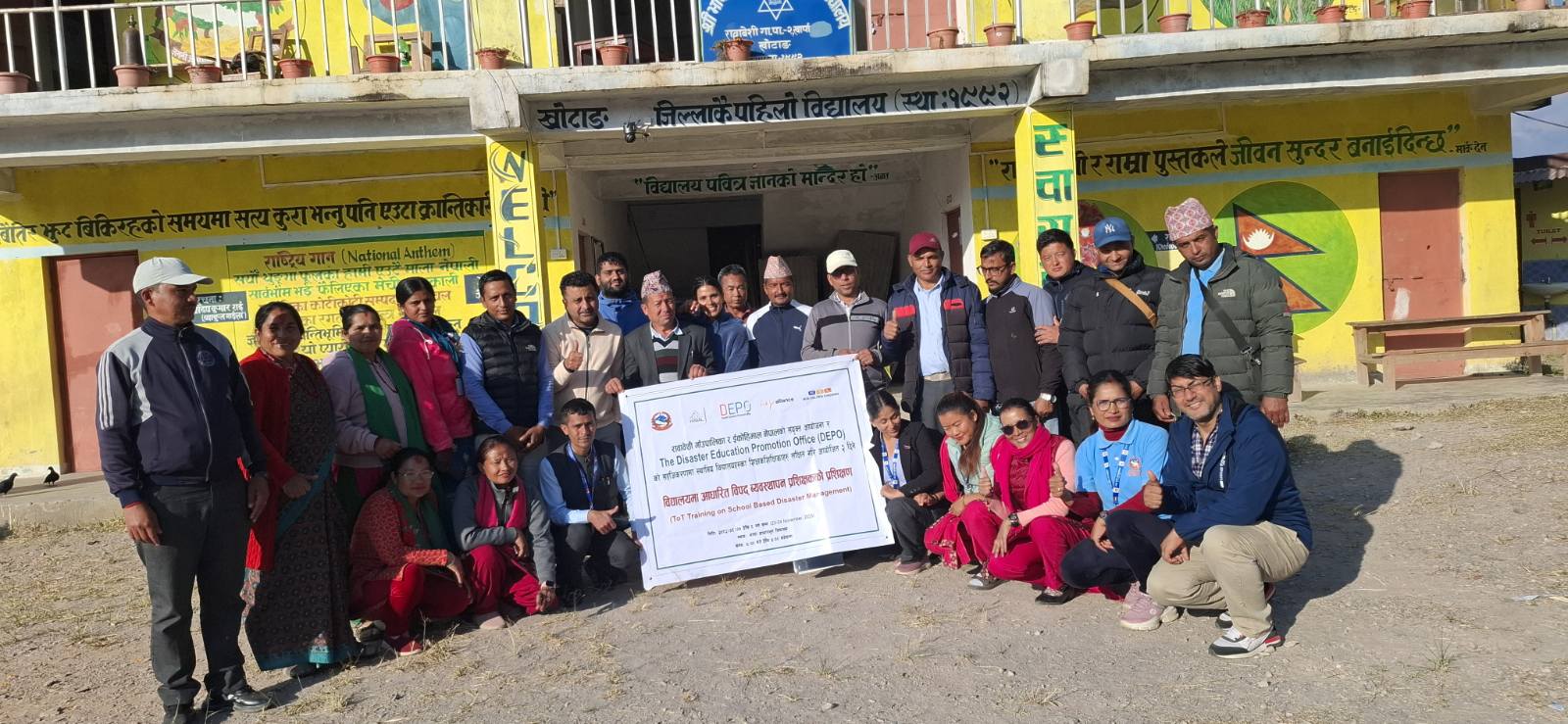
EcoHimal Nepal, seeking technical support for its Three-Star School Upgradation initiative, collaborated with the Disaster Education Promotion Office (DEPO) to deliver a comprehensive Disaster Risk Reduction (DRR) Training Programme at Bhasa Basic School, Ward No. 2, Rawabesi Rural Municipality, Khotang. With DEPO Nepal’s specialized expertise in disaster education and school safety, the programme was carried out under the Gender Friendly Himalayan School Project to strengthen preparedness, enhance DRR knowledge, and contribute to the creation of safer, more resilient learning environments in line with the Three-Star School Approach.
The three-day Training of Trainers (ToT) for teachers and students aged 12-15, a learning event, helped build practical skills, strengthen preparedness, and improve the overall safety culture within the school community.
Programme Objective
The training was designed to strengthen the capacity of teachers and students to prepare for and respond to disasters. The key objectives were:
- To improve knowledge and understanding of Disaster Risk Reduction (DRR) concepts
- To build practical first aid and emergency response skills among teachers
- To strengthen school-level disaster preparedness and safety planning
- To support teachers in integrating DRR messages into regular classroom activities, having classes on DRR preparedness each month on a regular basis
- To promote a safe, inclusive, and resilient learning environment aligned with the Three-Star School Approach, having teachers from different backgrounds, ethnicity, caste, language, and religion coming together as a community to learn about better preparation for disasters
Key Activities
A series of interactive and hands-on learning activities were conducted during the programme to ensure strong engagement and practical learning:
- Interactive games and simulations, including the Dodge Ball game, to introduce concepts of risk, vulnerability, exposure, and disaster
- Practical first aid training on bleeding control and fracture management
- Demonstration and practice of bed-sheet stretcher preparation using locally available materials
- Hazard, vulnerability, and risk assessment of the school and its area through field observation and group work
- Development of hazard and risk maps (of the school and its nearby area) using local and low-cost materials
- Conducting earthquake drills to practice safe evacuation and response
- Teacher-led demonstration sessions and student learning events on disaster preparedness
These activities increased confidence within the participants in handling real-life emergency situations.
Programme Outcomes
The programme achieved strong and practical results for the school and the wider community:
- Teachers gained improved knowledge and confidence in disaster preparedness and response as they shared their knowledge with students on the third day and are ready to include DRR in their classroom teaching
- Stronger practical skills in first aid, stretcher making, and emergency handling were developed through practical training
- The school enhanced its capacity to assess risks and plan for safety measures as they want to discuss the risks with teachers, parents, and ward officers
- Students developed better awareness of the use of locally available materials for first aid along with the preparation of an emergency bag before disaster
- The school management plans to make all school community members more prepared, coordinated, and resilient in the days to come, even making an action plan for the academic session
- The programme contributed directly to the implementation of the Three-Star School Approach